Home › Products › Patly Examiner
Patly ExaminerUpload the draft. A simulated panel of ten primary examiners, calibrated to the art unit your application classifies into, reads it under 101, 102, 103 and 112, retrieves the closest art and reads it against your claim set, charts claim 1 limitation by limitation, and returns the office action with an amendment and an argument drafted to every ground it raises.
Minutes, not months · $349 per application, no seats · never trained on, deleted when you ask
The same simulated examination answers a different question for everyone with a stake in a patent: whether to file it, fix it, fund it, buy it or fight it. Pick where you sit.
| Who | The question they bring | What they read first | What it changes |
|---|---|---|---|
|
Before filingRead the office action before the office writes it.
5 uses
| |||
Law firms and patent agentsProsecution practices of every size |
“Will this survive the first action, and is the answer ready if it does not?” | Fix the draft before it is filed, and meet the first action with the response already written. | |
Individual inventorsFiling on their own, or paying a firm to |
“Is this draft worth the filing fees, and does it claim everything it could?” | Know where the claims stand before paying to file them, and what to change if they come up thin. | |
Startups and foundersPatents pending, a round coming |
“Will the applications our investors ask about hold up?” | Walk into diligence with the likely rejection named and the answer already in the claims. | |
Universities and research labsTech transfer offices working with outside counsel |
“Is the draft outside counsel sent back ready to file?” | Send it back with specifics while it is still a draft, not after the first action arrives. | |
Applicants coming to the USClaims first drafted for another office |
“How will a US examiner read claims written for another office?” | Adapt the claims for US eligibility and means‑plus‑function reading before the US filing. | |
|
Quality and oversightKnow the work is good before anyone signs it.
3 uses
| |||
Companies that hire patent firmsIn‑house IP and legal teams |
“Is the firm we pay drafting to the standard we pay for?” | Measure every firm against the same field benchmarks, and give the next batch to the firm that earns it. | |
Law firms reviewing their own draftsPartners, before the client reads the draft |
“Does this draft meet our standard before the client sees it?” | Catch antecedent and support gaps in house, and keep the client who would have found them. | |
In‑house patent committeesDeciding what to file this quarter |
“Which of these drafts are ready, and which need work first?” | Rank the pipeline by how likely each draft is to issue, and spend the budget where it holds. | |
|
DisputesFind the weak claim before the other side does.
3 uses
| |||
Litigation and defense firmsAnswering an asserted patent |
“Where is the asserted patent weakest?” | Open the invalidity analysis, or an IPR petition, with the closest art charted and the indefinite terms flagged. | |
Patent owners before they assertPlaintiffs and their counsel |
“Which claims will hold once a defendant goes looking for art?” | Assert the claims that stand up, and know the fallback positions before the other side finds the weak ones. | |
Litigation fundersDeciding which patent cases to back |
“Is the patent behind this case strong enough to fund?” | Screen cases on validity risk before paying for full diligence. | |
|
Deals and diligenceDiligence on pending claims, before the term sheet.
3 uses
| |||
InvestorsVenture and growth funds |
“Will the applications this company counts on actually issue?” | See how each pending application is likely to fare before the term sheet, not after the first office action. | |
Acquirers, buyers and licenseesAcquisitions, portfolio purchases, licenses |
“How much of this portfolio is likely to issue as claimed?” | Negotiate on the claims likely to survive examination, not on the count of filings. | |
Insurers and IP lendersPricing risk on a portfolio |
“Would these claims hold up under examination?” | Underwrite on the strength of the claims, not the number of applications. | |
|
Public sector and teachingA consistent first read, at any volume.
2 uses
| |||
Patent offices and governmentsOffices facing rising application volumes |
“With applications rising, where should examiner time go first?” | A first read of every application that names the likely ground and the art behind it, for an examiner to confirm or set aside. | |
Law schools, clinics and examiner trainingTeaching prosecution |
“How do students practice answering a rejection before they have a real one?” | Realistic office actions on the students’ own drafts, with a prepared response to compare against. | |
Every tag opens that part of the sample report.
These are pages of the sample report, taken from the report itself. Every one names the claim, the paragraph, the statute and the reference it rests on, so you can check it the way you would check an associate.
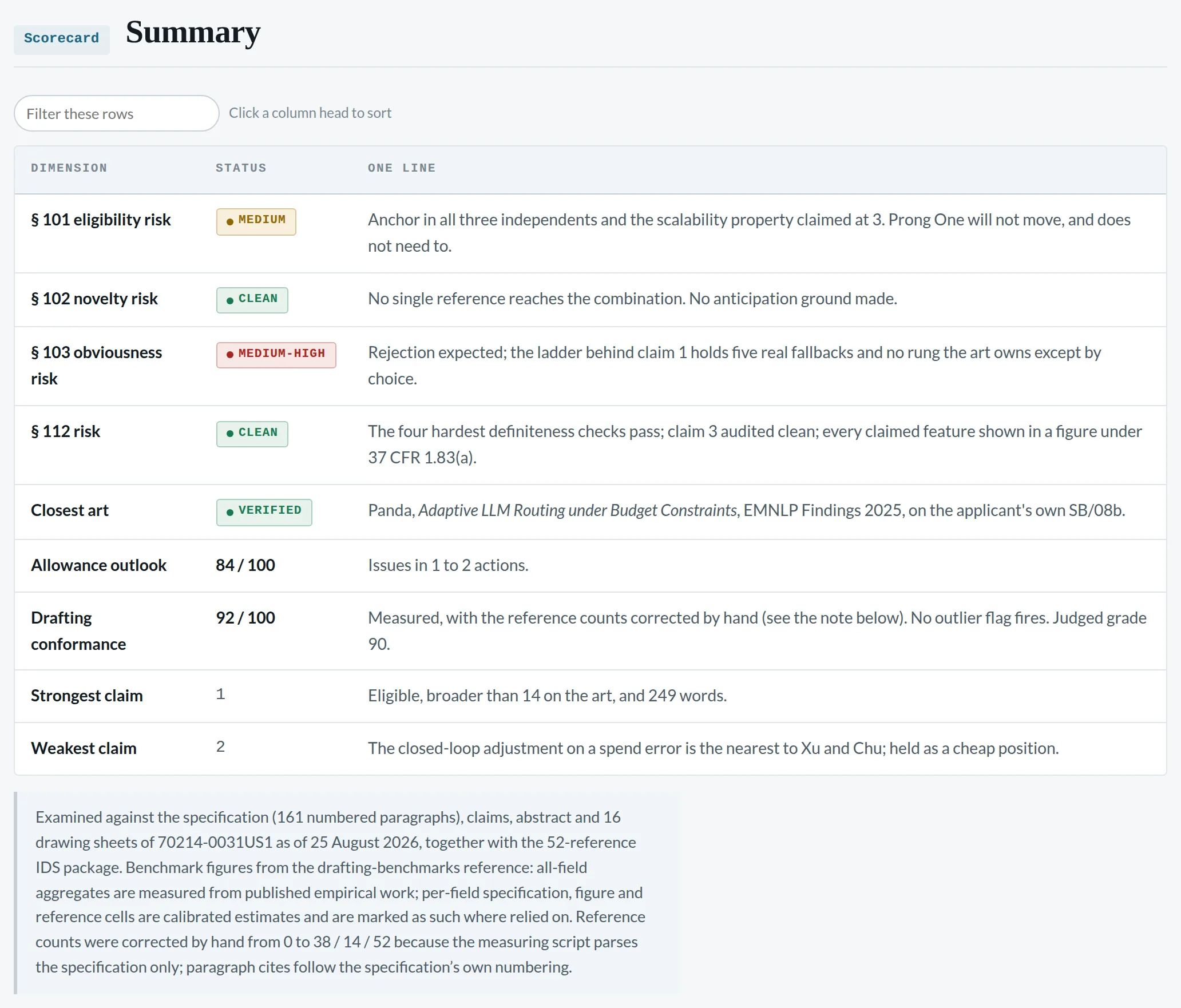
The report opens on the rejection you are most likely to get, whether it survives, and which dependent claim to roll up if it does. Then the allowance outlook, the drafting grade, and the office actions to expect against the field baseline.
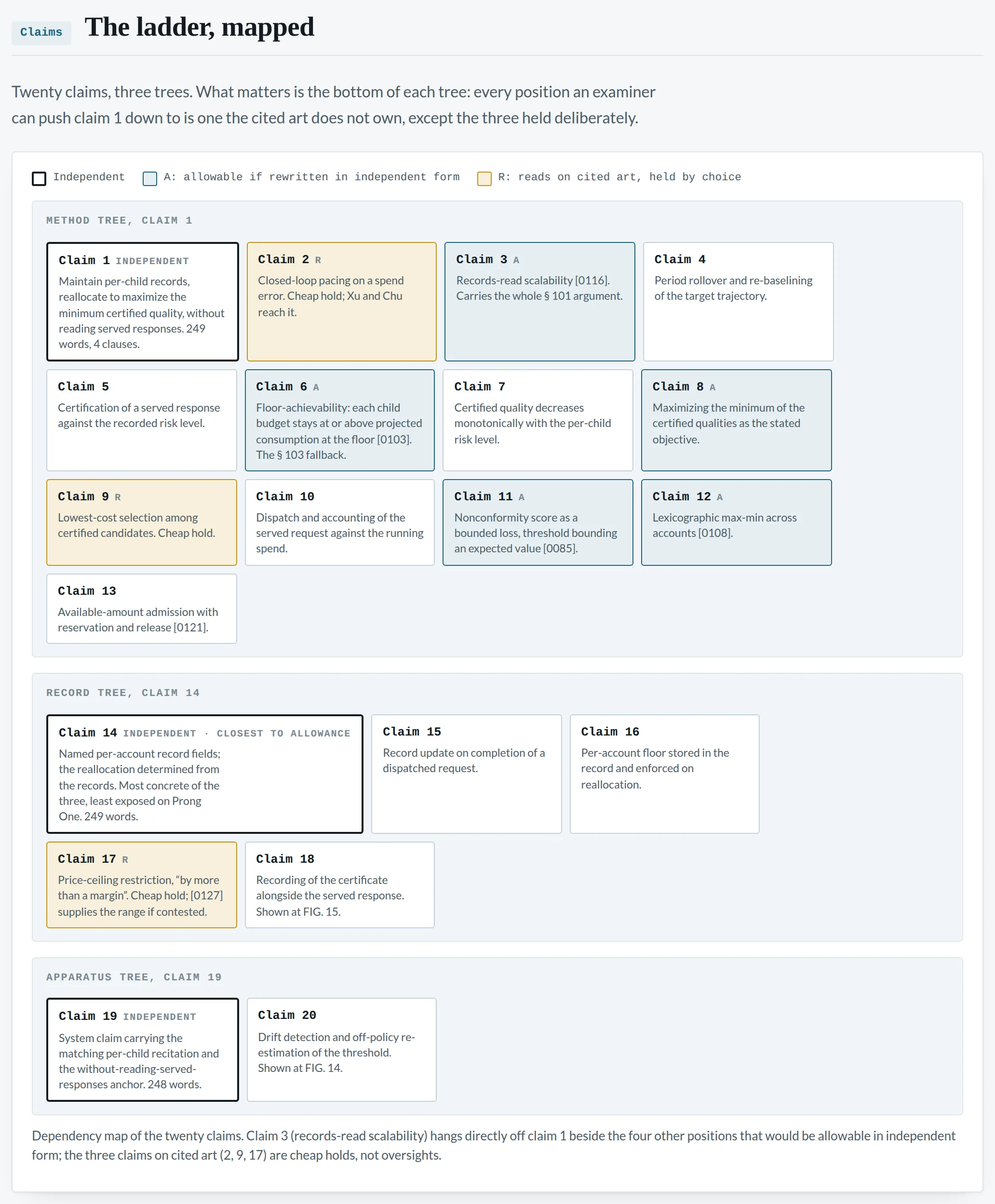
Under 103, claim 1 is charted against the primary and secondary references one limitation at a time: which reference teaches it, which reaches it only in part, and where the gap is. The dependency map shows the whole ladder, with the claims that are allowable in independent form and the ones that read on cited art and are held by choice.
| Limitation | Panda | Angelopoulos | Dean |
|---|---|---|---|
| [a]per-child budgets allocated from a parent | teaches | teaches | in part |
| [b]a threshold calibrated to a risk level | in part | teaches | absent |
| [c]idle capacity borrowed across children | absent | absent | teaches |
| [d]the floor held by the quality actually served | absent | absent | absent |
The gap is [d]. Nothing in the art measures an account's service level by the risk level at which its requests are certified. Response drafted: roll claim 6 into claim 1 and argue the motivation to combine on the record Panda itself sets out.
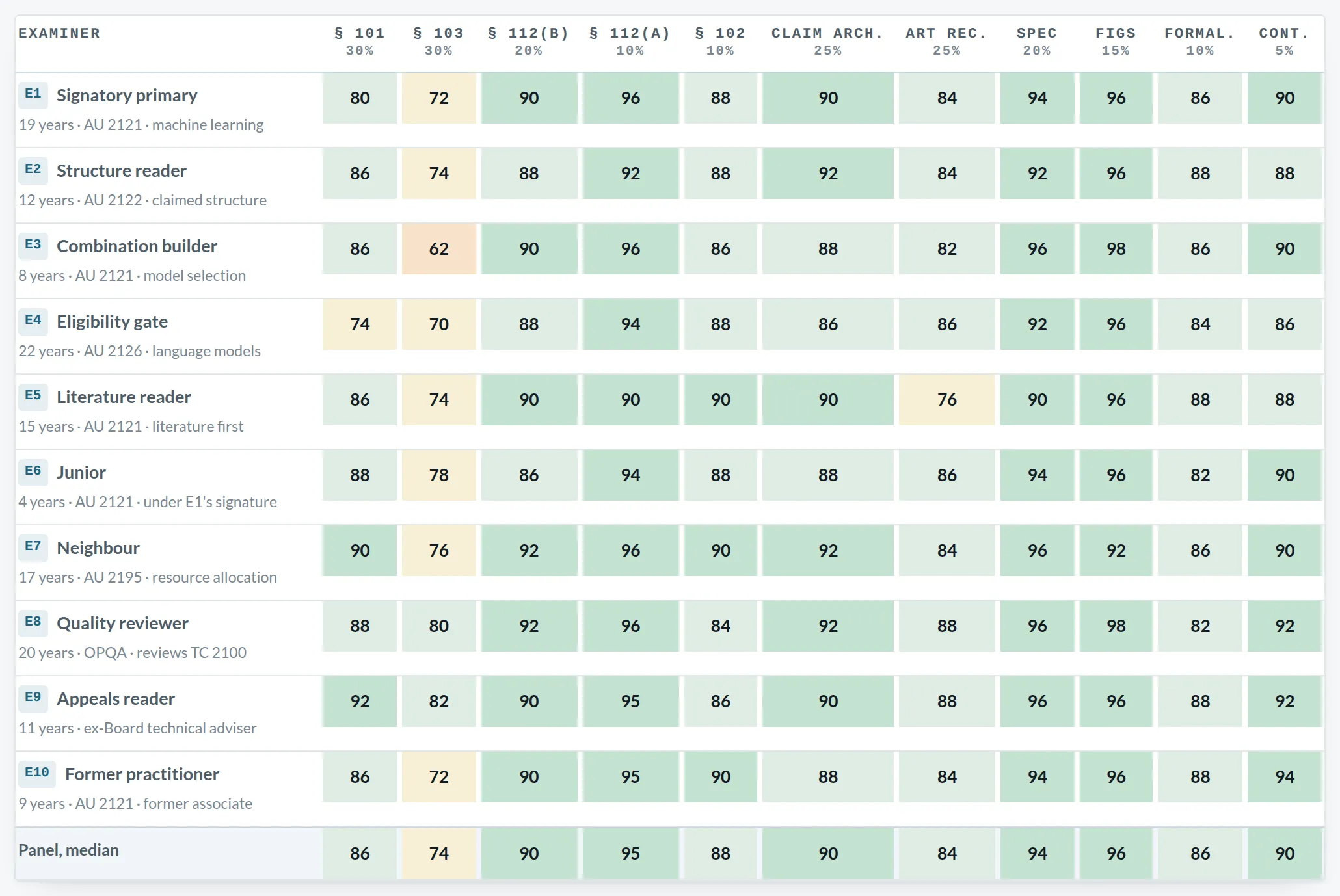
Each seat simulates a primary examiner from the art unit the application would be examined in, with the ground they search and what they read hardest for. Every one scores every dimension on their own; the matrix shows the spread, and the report says where the panel disagreed and why.
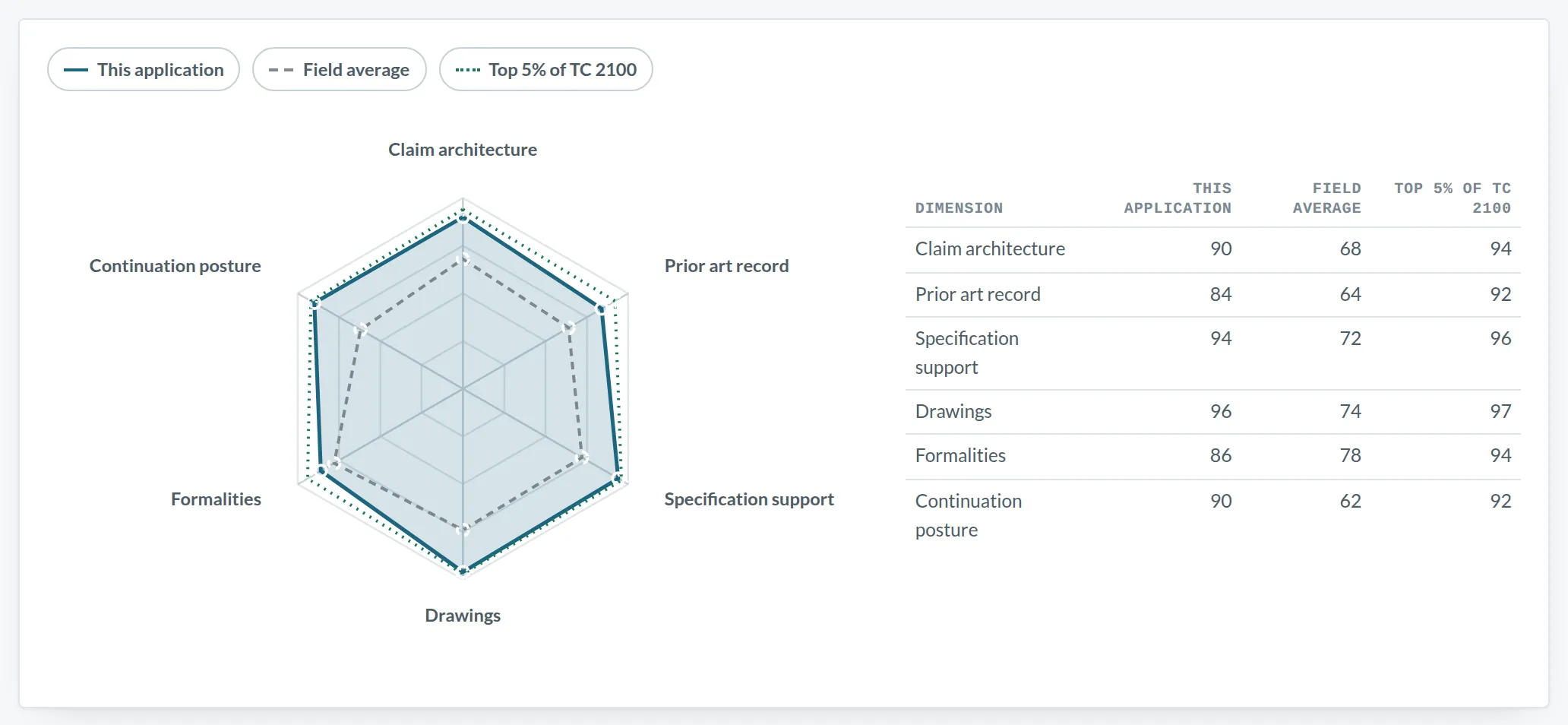
Eighteen measured quantities beside the population average and the top five percent for the technology center: specification length, figures, claim counts, dependents per independent, words in claim 1, references cited. The grade is out of 100, and the gaps that matter are the ones tied to a rejection.
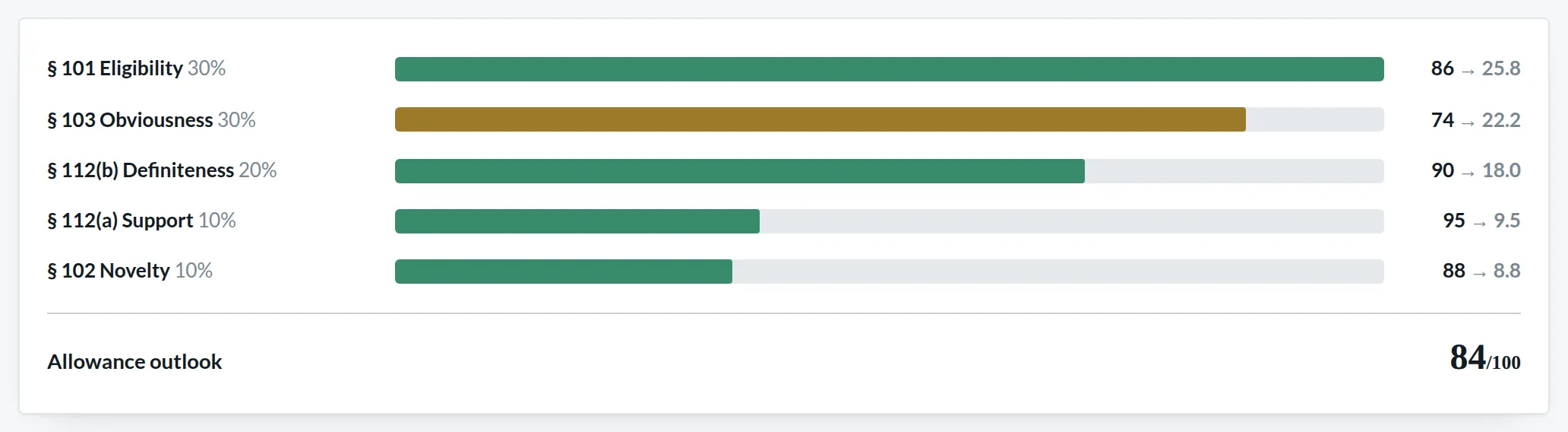
The rejection is written the way the office writes it, on references that were retrieved and read against their own records first. Under it sits the prepared response: the amendment worded, traced to your specification by paragraph, and the argument that goes with it, priced in the scope it costs.
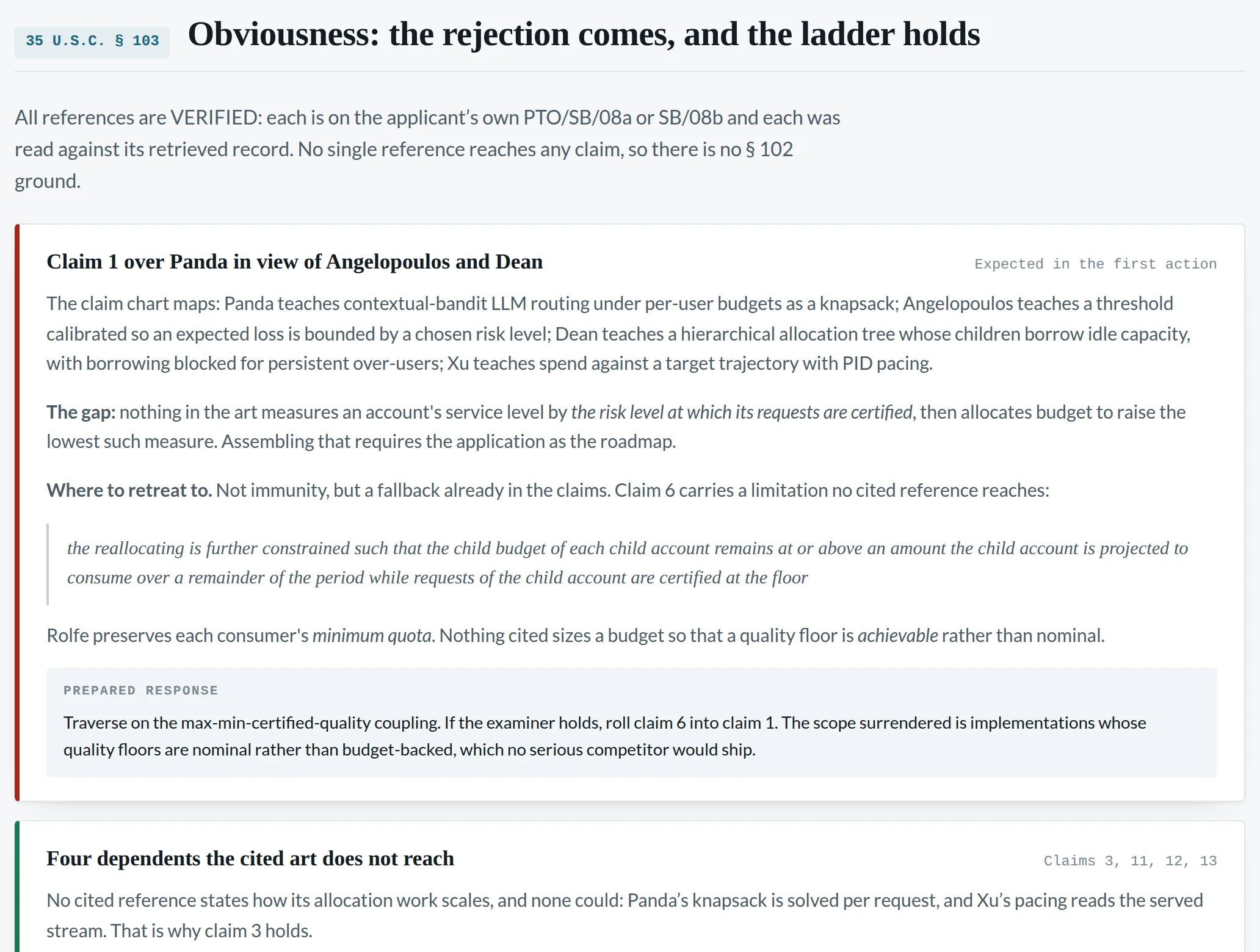
Office actions to allowance on the art unit's own numbers, the RCE risk, the first action expected, and the one roll that answers it either way. Then the actions ranked by effect on the outcome, and a sensitivity panel: tick an amendment and see what the panel's own weights say it would move.
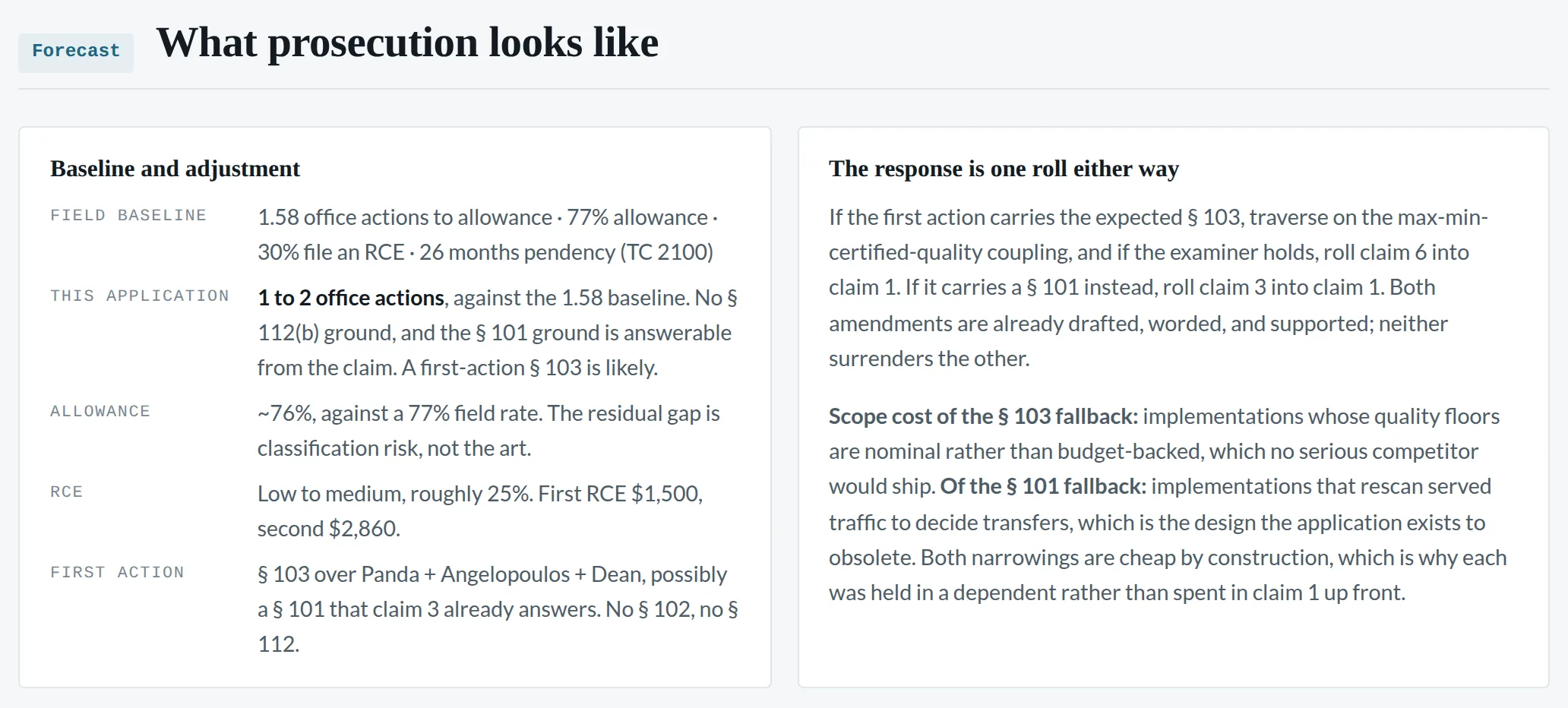
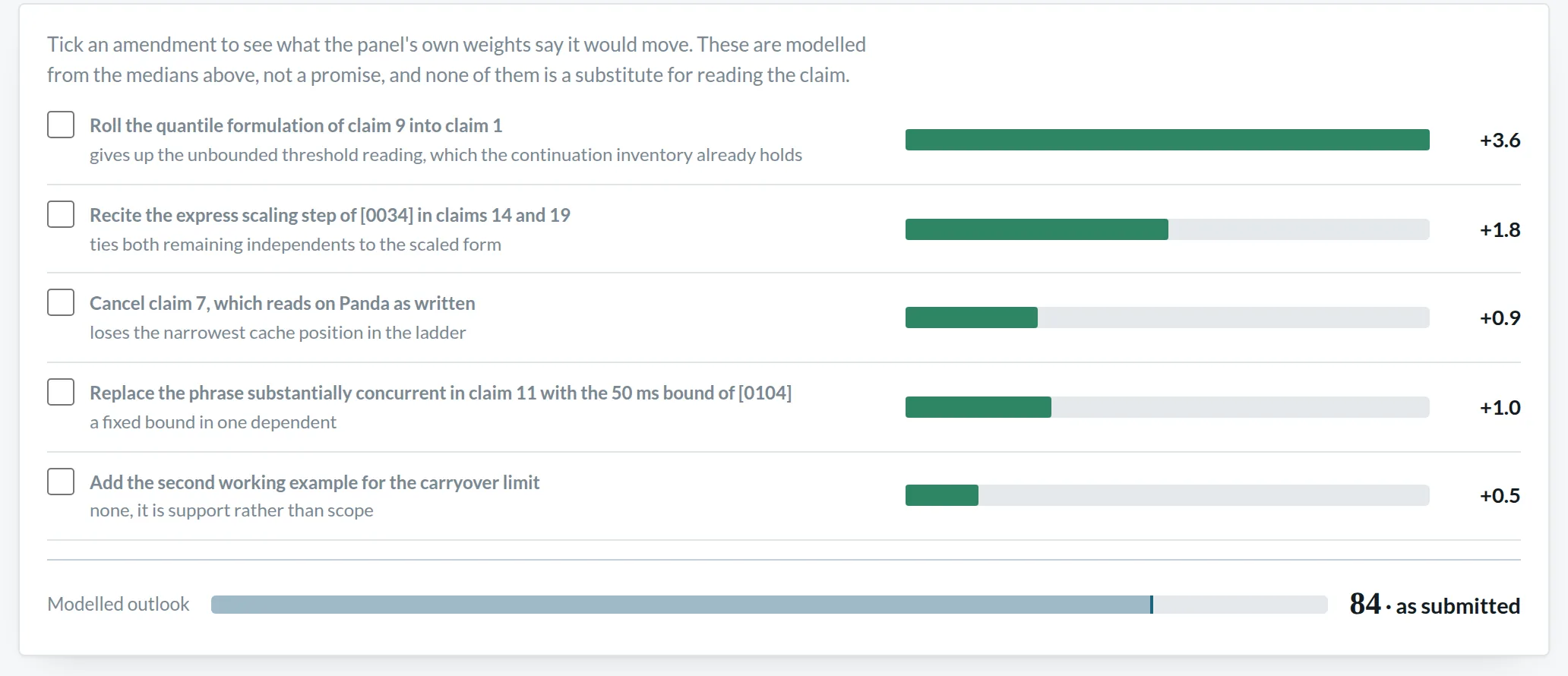
One ground per card, each tied to the claim language it reads on and to its MPEP section. Under 103, a claim chart for claim 1: one row per limitation, what reaches it, and where the gap is. Under 101, the two prongs walked with the language quoted. A ground that would not survive appeal is not raised, and the report says when the art does not reach the claims.
Every rejection arrives with the answer written: the amendment worded, traced to support in your own specification by paragraph, and priced in the scope it costs. Where a dependent claim would be allowable in independent form, the report says so and gives the reasons‑for‑allowance statement.
Eighteen measured quantities beside the population average and the top five percent for the technology center the application classifies into: specification length, figures, claim counts, dependents per independent, words in claim 1, references cited. The grade is out of 100, and the gaps that matter are the ones tied to a rejection.
In order: a one‑page summary, the verdict, the examiner panel, the claim ladder mapped, the field benchmarks, where the art was looked for, 112, 101, 102, 103, what is allowable and why, the prosecution forecast, the commercial value range, and the ranked actions. Patentability and drafting quality are scored separately and never allowed to contaminate each other: a well‑drafted application can be unpatentable, and a thin one can claim something novel.
A rejection built on a reference that does not say what it is quoted as saying is worse than no rejection at all. So the examination retrieves what it cites.
The examination is adversarial on purpose. It is paid to find the reason your claim should not issue, then to test whether that reason holds.
No plug‑in, no seat, no onboarding call. Ask us for a trial code to try it on a matter of your own, or step through the walkthrough first.
Upload the draftClaims and specification as DOCX or PDF, drawings and your IDS if you have them, or the whole thing as one zip. The intake reads the claim set on arrival and tells you what it found.
Watch it runParsed, searched, charted, written. The tracking page shows the stage it is on and opens the report the moment it is ready, and a copy goes to your inbox.
Review and fileYou decide what to change, you sign, you file. The report stays with the matter, and when the real action arrives you have already answered it.
against the $2,300 to $4,000 you bill for each office action response, and the $1,500 in USPTO fees for a first RCE, on a rejection you could have answered before filing.
Flat and published. Blocks bring the rate down and are drawn down as you run examinations.
Blocks are prepaid and drawn down as you run examinations. The office action response stays $299 at any volume. See the full practitioner price list, or university pricing if your office wants counsel to sign and file.
It is $349 per application, $299 each in blocks of 10 or more and $249 in blocks of 50 or more. The filing-ready bundle, which adds prior art with the IDS, drawings, and the filing review to the same order, is $599 per application.
Minutes. The tracking page shows each stage as it happens and opens the report itself when it is ready. A long record with a large drawing set takes longer than a short one, and the page says so while it runs.
Every reference is retrieved and read against its own record before it is cited. Publication number, date, assignee and the passage relied on are checked against the retrieved document, and anything that cannot be retrieved is labelled unverified, with no rejection resting on it. The report says which references came from your own IDS, which were retrieved, and which could not be served by any database we can reach.
No. Uploads stay in your account for the matter, are never used to train a model, and are deleted when you ask. No part of your draft is shared with another practitioner or another firm.
You do. The report is a simulated examination prepared for the practitioner of record. It is not a USPTO action, it is not legal advice, and Patly does not sign or file anything you order on this page.
Yes. It is the same examination whether the draft came from your own pen, from a client, from another firm, or from an agent. Practitioners who inherit a matter run it to find out what they have taken on.

Upload a draft and read the office action before you file it; ask us for a trial code to try it on a matter first.
or write to us at info@patly.ai
 PATLY.AI