Founded by PhDs and leading AI researchers. Request a pilot →

Find it. File it.
Win it.

One platform from the first idea to the allowed patent. Find what is new, file it fast, and see the office action before the examiner writes it, for universities, law firms, companies, inventors and government.

Attorney‑signed filings · flat prices, no hourly billing · free patent analytics to start

Keep publishing.
Keep the rights.

Companies clear every paper with IP counsel before it goes public. At a university, review happens only when a researcher walks in the door. Patly reads every paper your university publishes, ranks the patentable ones, and drafts the ones you choose. You decide what gets filed. Licensed counsel signs everything, at a flat $5,500 per non‑provisional.

Attorney‑signed · flat per‑filing pricing, no hourly billing · faculty change nothing

See the office action.
Before you file.

Patly Examiner simulates the examination your draft will get under 101, 102, 103 and 112, and returns the rejections with the responses drafted. Answer office actions at $299 each, order first drafts at $1,995, and know every examiner before you respond.

Per application, no seats · a trial code on request · you keep the client, the signature and the fee

File what holds up.
Skip what doesn’t.

Map every invention disclosure against the prior art, check outside counsel’s drafts before they are filed, and see how your company compares with its competitors at the patent office.

Priced per use · ten maps for $1,790 · Patly Examiner $349 per application

Know it is new.
Then protect it.

See what is already published before you spend on a patent, then have the application drafted at a fixed price: $1,995 for a non‑provisional, $495 for a provisional. USPTO filing fees are separate and are paid to the USPTO.

Fixed prices · one revision round · an automated reading, not a legal opinion

Fund what is new.
See the whole office.

Check whether a proposed or funded technology is already in the published record, and follow filings, outcomes and pendency across the patent office, year by year.

Free office statistics · $199 per proposal · an automated reading, not a legal opinion

Idea → Patent
01

Find what is new Automatic

Papers, disclosures and ideas, read against the patent offices and the research literature.

02

File it fast Days

Drafted from the paper or the disclosure, signed by licensed counsel, and filed in days.

03

Win at the office Minutes

The office action predicted before you file, and every response drafted when it comes.

Paper → Filing
01

Patly finds the paper Automatic

Preprints, journals, dissertations, and award feeds, screened the day they appear. No disclosure needed.

02

Draft in hours Hours

A filing‑ready non‑provisional from the paper itself: claims, specification, and figures.

03

Attorney signs, Patly files Days

Licensed counsel reviews and signs. Filed inside the 12‑month grace window, priority date locked.

Draft → Allowance
01

Examine the draft Minutes

The rejections a draft will draw under 101, 102, 103 and 112, with the responses drafted.

02

Answer the action Fixed price

Upload the office action with the application; the amendment and arguments come back drafted to revise and sign.

03

Know the examiner Free to start

Grant rate, difficulty and what works for every examiner, with the odds of each next step.

Disclosure → Portfolio
01

Map the disclosures Per map

Each comes back with its novelty and the closest references, from $199 a map.

02

Check the draft Minutes

Patly Examiner predicts the rejections before outside counsel files.

03

Benchmark the field Live

Allowance, speed and rejections, side by side with up to four competitors.

Idea → Application
01

Check the idea Automatic

The patent offices and the research literature, read against your write‑up, from $199.

02

Draft it 1 working day

The application, the claims and the figures, delivered within a working day of payment.

03

Answer the office Fixed price

When the office action comes, the response arrives drafted for you to revise and sign.

Proposal → Decision
01

Read it against the art Automatic

The closest published art, read element by element, from $199 per proposal.

02

Follow the office Free

Filings, outcomes and pendency by tech center and domain, year by year.

03

Talk to the team Pilots

Screening and attorney‑signed filing run with pilot universities; describe your lab and the team will tell you what fits.

The live queue: papers screened, patentability flagged, candidates ranked. Dollar figures are a triage signal, not an appraisal.

Everything Patly does

From the research paper to the allowed patent

Find what is worth protecting, file it well, and win it at the office. Each part works on its own, at a flat, published price.

Findwhat is new, and worth protecting
Detection: the capture queue, with papers screened, file-ready inventions and the selection for filing
Find

Detection and ranking

Every paper your university publishes, read and ranked, with the shortlist routed to your office.

$2,000 a month, or $19,995 a yearExplore detection →
Prior art explorer: a claim mapped element by element against the closest references, with its novelty score
Find

Prior art explorer

Every reference read against every claim element, on a map you can revise the claims inside and watch novelty move.

$199 per applicationMap an application →
Patent analytics: the outcome simulator on an examiner's page, with where you are, your next move, and the odds that follow
Find

Patent analytics

Every examiner, art unit, company, firm, inventor and technology: grant rates, difficulty, what works, and the odds from where you stand.

Free to start, Pro $29 a monthOpen analytics →
Filea strong application, fast
Attorney-signed filing: a selected disclosure with its patentability, patent clock and recommended filing
File

Attorney-signed filing

A filing-ready non-provisional drafted from the paper itself, signed by licensed counsel, and filed in days.

Patent drafting: a paper, an idea or a disclosure in; the application, claims, figures and filing guide out
File

Patent drafting

The application, the claims and the figures drafted from your paper, idea or disclosure, with one revision round.

$1,995 non-provisional, $495 provisionalOrder a draft →
Prior art, drawings and review: the IDS, the figures and the filing review before Patent Center
File

Prior art, drawings and review

Prior art with the IDS, drawings to USPTO standard and a filing review, or all of them with the examination as one bundle.

Bundle $599 ($776 separately)See the package →
Winat the office, round after round
Patly Examiner: the rejections a draft will draw, mapped to its claims, with the response drafted
Win

Patly Examiner

Simulates the examination a draft will get under 101, 102, 103 and 112, and returns the rejections with the responses drafted.

$349 per application, $299 in blocks of 10Examine a draft →
Office action response: each ground of rejection read and answered, with an interview agenda
Win

Office action response

Upload the office action with the application it was mailed against; the amendment and arguments come back drafted for you to revise and sign.

$299 per office actionAnswer an action →

A question about any of it? Ask Patly, bottom right, answers from these pages, and a person is a click away.

Who it is for

One platform, five ways in

Each card plays real cases: who comes to Patly, what they bring, and what they leave with.

Universities

Every paper read and ranked; the inventions your office approves drafted from the paper, attorney-signed and filed in days.

Detection Technology transfer director

Hundreds of papers a month, and disclosures only from faculty already chasing a startup or a license.

Complete coverage, with no new workflow for faculty and no new headcount for the office.

DetectionFilingPrior artAnalytics
Request a pilot See their use cases →

Law firms and practitioners

See the office action before you file, and answer the ones you get at a fixed price.

Patly Examiner $349 · responses $299
Drafting Solo practitioner or patent agent

A new client, and no time to write the first draft.

You keep the client, the signature and the fee.

DraftingPrior artPackageExaminerResponseAnalytics
For law firms See their use cases →

Companies

Fund the disclosures that hold up against the art, and check outside counsel’s drafts before they are filed.

$179 a disclosure in a ten-pack
Drafting Startup founder

An invention ready to protect, and a budget that cannot carry firm rates.

A complete application at a fixed price.

DraftingPrior artExaminerResponseAnalytics
Map a disclosure See their use cases →

Inventors

Know what is already published before you spend, then have the application drafted at a fixed price.

Check for $199 · draft for $1,995
Drafting Independent inventor

You want a priority date before you show the invention to anyone.

Your date held while you test the market.

DraftingPrior artPackageResponse
Check your idea See their use cases →

Government

Check whether a proposed or funded technology is really new, element by element, before the decision.

$199 per proposal
Prior art Technology transfer officer

A lab scientist sent an invention disclosure.

Know whether it holds up before the patent budget is spent.

Prior artExaminerAnalytics
Talk to us See their use cases →
Use cases

Every product, through the people who use it

Pick a product: each case starts with the person, then the situation, the steps, the outcome and what it costs.

Detection and ranking

Every paper your university publishes, read and ranked, with the shortlist routed to your office.

Explore detection →
Technology transfer directorR1 university · University

Hundreds of papers a month, and disclosures only from faculty already chasing a startup or a license.

  1. Patly reads every paper the university publishes
  2. Each candidate arrives ranked, with its reasoning
  3. Your office accepts or passes on each one

Complete coverage, with no new workflow for faculty and no new headcount for the office.

$2,000 a month, or $19,995 a yearExplore detection →
Licensing associateTechnology transfer office · University

A strong paper went out last month, before anyone thought to file.

  1. The candidate is flagged with its grace clock
  2. Your office approves it
  3. A non-provisional is drafted from the paper and filed

Filed inside the 12-month grace window, priority date locked.

Vice president for researchResearch university · University

You want to see what a year of your papers is worth before committing to anything.

  1. Ask for a free report from your own papers
  2. See the candidates ranked, with the reasoning
  3. Decide on a pilot with the evidence in hand

A ranked picture of your own research, at no cost.

Attorney-signed filing

A filing-ready non-provisional drafted from the paper itself, signed by licensed counsel, and filed in days.

Explore filing →
Technology transfer officeAfter an approval · University

The office approved an invention found in a faculty paper.

  1. A filing-ready non-provisional is drafted from the paper
  2. Licensed counsel reviews and signs it
  3. It goes to the USPTO

From approval to a filed application in days.

Filed in daysExplore filing →
Faculty inventor, with the officeResearch lab · University

The office needs time to decide, and the clock is already running.

  1. File a provisional, attorney-signed
  2. It holds the priority date for 12 months
  3. Convert it whenever the office is ready

The date is secured while the decision is made.

$995 per provisionalExplore filing →
Office with a yearly filing budgetTechnology transfer office · University

Thirty approved inventions to file this year, and a budget to plan around.

  1. Prepay a block of filings
  2. Each approved invention is drafted and signed
  3. File each one as it is ready

Flat rates the budget can plan around.

$5,250 each at 12 or more, $5,000 each at 30 or moreExplore filing →

Patent drafting

The application, the claims and the figures drafted from your paper, idea or disclosure, with one revision round.

Order a draft →
Solo practitioner or patent agentSmall practice · Law firm

A new client, and no time to write the first draft.

  1. Send the disclosure
  2. The application, claims and figures come back within a working day of payment
  3. Revise once, then sign and file under your own name

You keep the client, the signature and the fee.

$1,995 per non-provisional draft · Within a working dayOrder a draft →
Startup founderVenture-backed company · Company

An invention ready to protect, and a budget that cannot carry firm rates.

  1. Share the paper, idea or disclosure
  2. The application, claims and figures are drafted
  3. Licensed counsel reviews, signs and files

A complete application at a fixed price.

$1,995 per non-provisional, USPTO fees separate · Within a working dayOrder a draft →
Independent inventorWorking on your own · Inventor

You want a priority date before you show the invention to anyone.

  1. Describe the invention
  2. A provisional application is drafted
  3. File it to hold your date for 12 months

Your date held while you test the market.

$495 per provisional draftOrder a draft →

Prior art explorer

Every reference read against every claim element, on a map you can revise the claims inside and watch novelty move.

Map an application →
Associate at a law firmProsecution group · Law firm

The draft claims are ready and the filing is next week.

  1. Map the draft claims
  2. Every reference is read against every claim element
  3. Revise the claims inside the map and watch novelty move

Claims shaped against the art before the examiner sees them.

$199 per applicationMap an application →
IP managerProduct company · Company

Dozens of invention disclosures and one filing budget.

  1. Map each disclosure
  2. Each comes back with its novelty and its closest references
  3. Fund the ones that hold up

The budget goes to the disclosures that hold up against the art.

$1,790 for ten, $179 eachMap an application →
Independent inventorBefore spending on a patent · Inventor

Is the idea already out there?

  1. Paste your write-up
  2. The patent offices and the research literature are searched
  3. See what is already published, element by element

Know before you spend on an application. An automated reading, not a legal opinion.

$199 per applicationMap an application →
Licensing associateBefore approving a filing · University

A faculty paper looks patentable, and the office wants to know what is already out there.

  1. Map the paper's claims
  2. Every reference is read against every claim element
  3. Approve the filing with the closest art in view

Filings approved on the published record, not on hope.

Technology transfer officerFederal laboratory · Government

A lab scientist sent an invention disclosure.

  1. Map the disclosure
  2. The patent offices and the research literature are searched
  3. See its novelty and the closest references

Know whether it holds up before the patent budget is spent.

$199 per disclosureMap an application →
Program managerFunding agency · Government

A proposal claims a new technology, and the panel meets soon.

  1. Paste the technical summary
  2. The closest art is read element by element
  3. Score the proposal on what is really new

Funding decisions made with the published record in view.

$199 per proposalMap an application →

Prior art, drawings and review

Prior art with the IDS, drawings to USPTO standard and a filing review, or all of them with the examination as one bundle.

See the package →
Patent attorneyFiling this week · Law firm

The draft is final; the IDS, the drawings and a last check remain.

  1. Order prior art with the IDS
  2. Drawings rendered to USPTO standard from the specification
  3. A filing review before it goes in

Everything the filing needs, on one order.

$599 with the examination, against $776 separatelySee the package →
Patent paralegalLaw firm · Law firm

An information disclosure statement to prepare for a client application.

  1. Send the application
  2. The prior art is found and listed
  3. The IDS comes back ready to file

The disclosure statement prepared, not assembled by hand.

$199 per applicationSee the package →
Inventor drafting their own applicationWorking on your own · Inventor

The text is done; the figures are not.

  1. Send the specification
  2. Drawings are rendered to USPTO standard
  3. Add them to the filing

Figures that meet the drawing rules.

$149 a set of up to fifteen figures, and $12 for each figure after thatSee the package →

Patly Examiner

Simulates the examination a draft will get under 101, 102, 103 and 112, and returns the rejections with the responses drafted.

Examine a draft →
Partner at a law firmBefore an important filing · Law firm

A draft is about to be filed for a client that matters.

  1. Upload the draft
  2. The examination is simulated under 101, 102, 103 and 112
  3. The rejections come back with the responses drafted

The office action seen before filing, while the claims can still change.

$349 per application · Minutes, not monthsExamine a draft →
In-house patent counselCompany legal team · Company

Outside counsel sent a draft for approval.

  1. Run the draft through Patly Examiner
  2. See the predicted rejections and the strongest claim
  3. Send counsel specific changes

Drafts approved on evidence, not on instinct.

$299 each in blocks of 10 · Minutes, not monthsExamine a draft →
Agency patent counselGovernment agency · Government

Outside counsel sent a draft for an agency invention.

  1. Upload the draft
  2. The examination is simulated under 101, 102, 103 and 112
  3. Send counsel the predicted rejections to fix first

The draft tested before the office sees it.

$349 per application · Minutes, not monthsExamine a draft →
Firm with a filing volumeProsecution practice · Law firm

Fifty applications a year, each worth examining before it is filed.

  1. Buy a block of applications
  2. Examine every draft before it is filed
  3. Priced per application, with no seats

Every filing examined first, at a fixed price per application.

$249 each in blocks of 50, no seatsExamine a draft →
Any practitionerTrying it first · Law firm

You want to see it work on a real matter before buying.

  1. Ask for a trial code
  2. Run it on a matter of your own
  3. Compare the result with your own read

A judgment made on your own work, not a demo.

A trial code, on requestAsk for a trial code →

Office action response

Upload the office action with the application it was mailed against; the amendment and arguments come back drafted for you to revise and sign.

Answer an action →
Solo practitionerClient matter · Law firm

A non-final rejection on a client application.

  1. Upload the office action with the application
  2. Every rejection and cited reference is read
  3. The amendment and arguments come back drafted to revise and sign

The response drafted at a fixed price, against the $2,300 to $4,000 it is usually billed at.

$299 per office actionAnswer an action →
In-house counselAfter a final rejection · Company

A final rejection, and a choice between an RCE and an appeal.

  1. See the examiner's record after final rejections in patent analytics
  2. Draft the response with Patly
  3. Choose the route with the RCE fee in view

A response and a route chosen on evidence.

$299 per office action; a first RCE costs $1,500 at the USPTOAnswer an action →
Independent inventorFirst office action · Inventor

Your first office action has arrived, and there is no attorney yet.

  1. Upload the action and your application
  2. Read each rejection against its reference
  3. Revise the drafted response and sign it

A professional starting point for your reply. Not legal advice.

$299 per office actionAnswer an action →

Patent analytics

Every examiner, art unit, company, firm, inventor and technology: grant rates, difficulty, what works, and the odds from where you stand.

Open analytics →
Patent attorneyBefore a response · Law firm

A response due to an examiner you have never faced.

  1. Look up the examiner
  2. See the grant rate, the interview benefit and what works
  3. Run the outcome simulator on your options

The next step chosen with the examiner's own record.

Grant rate and difficulty free; Pro $29 a month · InstantOpen analytics →
IP strategistProduct company · Company

How does the company compare with its competitors at the office?

  1. Put up to four companies side by side
  2. Compare allowance, speed and rejections
  3. See who leads on each measure

A benchmark built on every application, not anecdotes.

Pro $29 a month · InstantOpen analytics →
Technology transfer officeEntering a field · University

Who leads in the field the office is about to file into?

  1. Search the technology
  2. See the inventors, companies and places behind it
  3. Follow the trend year by year

Know the field before filing into it.

Free to start · InstantOpen analytics →
Policy analystPublic agency · Government

How have allowance and pendency moved across the office?

  1. Open the office view
  2. Read filings, outcomes and pendency year by year
  3. Drill into tech centers and domains

The office as a whole, in one place.

Free · InstantOpen analytics →
The problem

Most patentable research never reaches the TTO

One R1 university, one year of published output:

9,000
papers published
one year of research output
1,350
hold patentable subject matter
about 15% of everything published
218
actually protected today
at best 16% of the pool, roughly what ever reaches the TTO
1,132
never reached the TTO
patentable papers published with no review at all

We are not claiming all 1,132 should have been filed. Most should not be. The point is that nobody with filing authority ever looked: disclosure depends on a researcher walking in the door, and most never do. The five to twenty a year you would have wanted are somewhere in that pile, and once published without a patent, any company in the world can use them for $0.

Why it happens

Why the good ones get missed

Three structural reasons, and none of them is anyone's fault.

The TTO never knows

The TTO only sees what researchers bring in, and typically the only ones who come in are chasing a startup. Everyone else publishes straight to arXiv and journals, and their work never becomes a disclosure.

$10k to $15k per filing

Firms bill $10,000 to $15,000 to draft and file a single non‑provisional, so offices can only afford to file the sure bets.

Weeks to draft

Each filing takes weeks of specialized drafting, labor that tech transfer offices cannot hire or scale fast enough.

What reaches the TTO gets judged carefully. The sure bets in the other 84% were never judged at all.

The universities that create the IP become the ones who capture its value.

Our mission →
Complete coverage, your call

Complete coverage. Your call on every filing.

Cheap drafting is not a reason to lower the bar. It is what makes a real review of everything affordable, and what turns the decision back over to you.

You decide, always

Every candidate arrives ranked with its reasoning, and your office accepts or passes. Nothing is drafted or filed without you.

Ranked, not filtered

You see the whole picture, ranked, with the grace clock on every candidate. Nothing is hidden from you, and nothing is decided on your behalf.

You grade our ranking

Run one year of your own papers and judge the ranking yourself. If the top of the list is not work you would defend filing, we have not earned the engagement.

What Patly.ai changes

Every paper gets a first read. Your office gets the ranked picture.

Everyone else starts at the disclosure. We start at the paper. No new workflow for faculty, no new headcount for the TTO.

1 · SCREEN

Screen everything

AI reads every paper the university publishes and ranks the candidates, so nothing depends on who walks in the door.

2 · DRAFT

Draft in hours

A filing‑ready non‑provisional is written from the paper itself: claims, specification, and figures.

3 · FILE

File, attorney‑signed

Licensed patent counsel reviews and signs every filing before it goes to the USPTO.

$10,000 to $15,000  →  $5,500

to draft and file a non‑provisional, so cost stops deciding what gets protected.

For universities

Detection and filing, one review layer

Detection finds and ranks everything your university publishes. Filing protects the ones you approve, attorney‑signed.

01 · DETECTION

Detection and ranking

Continuous review of everything the university publishes, ranked, with the shortlist routed to your office.

  • Preprints, journals, and grant awards monitored continuously
  • Patentability triage and the grace clock on every candidate
  • License and startup potential, forecast over five years
02 · FILING

Attorney‑signed filings

A filing‑ready non‑provisional drafted from the paper itself, signed by licensed counsel, and filed in days.

  • Buying in blocks: 12+ non‑provisionals at $5,250 each, 30+ at $5,000 each
  • Filed individually: $5,500 per non‑provisional, $995 per provisional
  • Every filing reviewed and signed by licensed patent counsel
from $995/filingExplore filing
Working product

Running today on real published research

A representative R1's published papers, most recent 365 days: the full queue ranked, and a five‑paper selection your office would actually sign off on.

1,045
works past the first invention screen, ranked in one queue
357
papers file‑ready today: past the patentability screen and ready to draft
$18,490 vs $45,500
the five filings actually selected: Patly vs typical attorney fees

The selection panel from the live product, on a representative R1's real papers. Dollar values are a triage signal, not an appraisal.

We prepare the same shortlist report for your university before our first meeting, at no cost.

Get your free report
Published output only

Built from preprints, journals, and grant awards. No lab notebooks, nothing confidential.

Attorney‑signed

Licensed patent counsel reviews and signs every filing before it goes to the USPTO.

On the grace clock

Every candidate is ranked against the 12‑month window while it is still patentable.

7 applications filed

Seven patent applications filed on how Patly works, from finding the paper to filing it.

Pricing

Simple pricing, built for selective filing

One detection subscription and flat per‑filing rates. Annual billing gets two months free.

01 · Detection and ranking

Detection, monthly

Every paper screened and ranked, with the shortlist routed to your office

$2,000/momonth to month · cancel any time
  • Continuous review of preprints, journals, dissertations, and award feeds
  • Patentability triage with grace clock alerts
  • A written assessment on every candidate, with licensing and startup potential
  • Live ranked queue and shortlist routing through your TTO, docket export included
Most popular

Detection, annual

The same product, billed once a year at a rate your office budgets once

$19,995/yrsave $4,005 · two months free
  • Everything in Detection, monthly
  • Quarterly shortlist review with our team
  • One number, budgeted once, no per‑seat pricing
02 · Attorney‑signed filing
Most popular

Non‑provisional

$5,500per filing · flat, attorney‑signed
  • Drafted from the paper itself: claims, specification, and figures
  • Licensed patent counsel reviews and signs before anything is filed
  • From approval to filed application in days

Provisional

$995per filing · holds your date for 12 months
  • The fast, low‑cost way to secure a priority date while you decide
  • Attorney‑signed, like everything we file
  • Convert to a non‑provisional whenever your office is ready
Buying in blocks
Single filings$5,500per non‑provisional
Block of 12+$5,250per non‑provisional
Block of 30+$5,000per non‑provisional

Blocks are prepaid and drawn down as your office approves filings. Provisionals stay $995 at any volume.

$5,500 per non‑provisional

against the $10,000 to $15,000 your firm bills to draft and file a single non‑provisional.

An entirely untapped market

Companies file nearly all the IP.
Universities create nearly all of it.

Patly will change the entire IP market by protecting the hundreds of thousands of valuable patents that top universities create and never even see.

What Patly protects Hundreds of thousands

of valuable patents top universities create and never even see

Also from Patly

Patly Examiner: the office action, before you file

Universities are where Patly starts. The same team built a simulated examination for anyone with a patent at stake: a panel of ten simulated primary examiners from the application’s own art unit reads it under 101, 102, 103 and 112, retrieves and reads the closest art, and returns the rejections with the responses already drafted. Minutes, not months, at $349 an application.

  • The rejections you are going to getUnder 101, 102, 103 and 112, with the closest art retrieved, read and charted against claim 1.
  • The responses, already draftedAn amendment and an argument for every ground, traced to the specification by paragraph.
  • Measured against your fieldA drafting grade against the top five percent, and a forecast of the prosecution ahead.
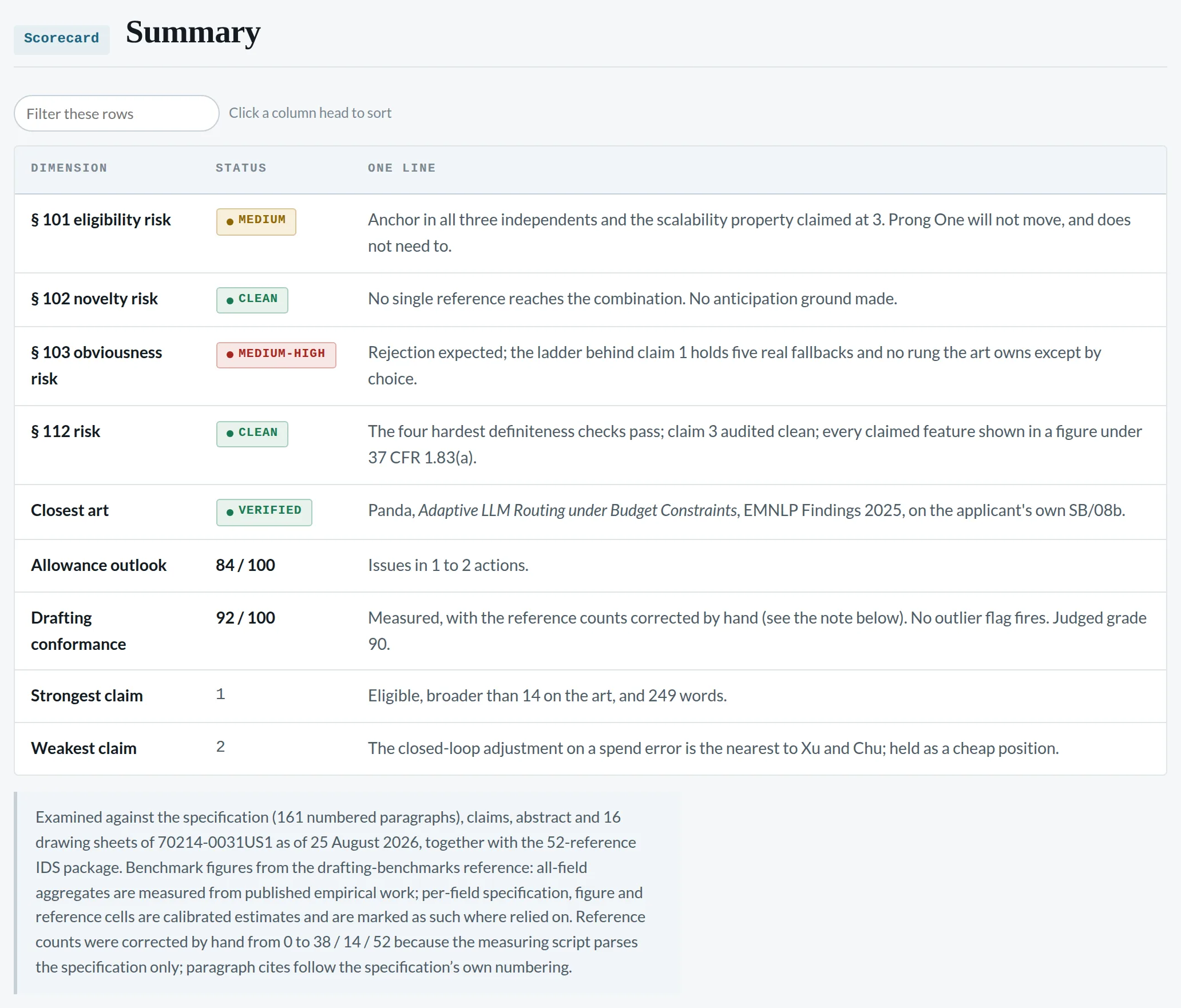
Sample report · summary
The summary that opens every report: each statutory risk, the closest art, the allowance outlook, the strongest and weakest claims, and the three things to do first

The summary that opens every report. Read the whole sample →

Who uses it, and what each one reads first

Every use, on the Patly Examiner page →
Who uses Patly Examiner: the question each party brings, the parts of the report they read first, and what it changes for them
WhoThe question they bringWhat they read firstWhat it changes
Before filingRead the office action before the office writes it. 5 uses
Law firms and patent agentsProsecution practices of every size
“Will this survive the first action, and is the answer ready if it does not?” Fix the draft before it is filed, and meet the first action with the response already written.
Individual inventorsFiling on their own, or paying a firm to
“Is this draft worth the filing fees, and does it claim everything it could?” Know where the claims stand before paying to file them, and what to change if they come up thin.
Startups and foundersPatents pending, a round coming
“Will the applications our investors ask about hold up?” Walk into diligence with the likely rejection named and the answer already in the claims.
Universities and research labsTech transfer offices working with outside counsel
“Is the draft outside counsel sent back ready to file?” Send it back with specifics while it is still a draft, not after the first action arrives.
Applicants coming to the USClaims first drafted for another office
“How will a US examiner read claims written for another office?” Adapt the claims for US eligibility and means‑plus‑function reading before the US filing.
Quality and oversightKnow the work is good before anyone signs it. 3 uses
Companies that hire patent firmsIn‑house IP and legal teams
“Is the firm we pay drafting to the standard we pay for?” Measure every firm against the same field benchmarks, and give the next batch to the firm that earns it.
Law firms reviewing their own draftsPartners, before the client reads the draft
“Does this draft meet our standard before the client sees it?” Catch antecedent and support gaps in house, and keep the client who would have found them.
In‑house patent committeesDeciding what to file this quarter
“Which of these drafts are ready, and which need work first?” Rank the pipeline by how likely each draft is to issue, and spend the budget where it holds.
DisputesFind the weak claim before the other side does. 3 uses
Litigation and defense firmsAnswering an asserted patent
“Where is the asserted patent weakest?” Open the invalidity analysis, or an IPR petition, with the closest art charted and the indefinite terms flagged.
Patent owners before they assertPlaintiffs and their counsel
“Which claims will hold once a defendant goes looking for art?” Assert the claims that stand up, and know the fallback positions before the other side finds the weak ones.
Litigation fundersDeciding which patent cases to back
“Is the patent behind this case strong enough to fund?” Screen cases on validity risk before paying for full diligence.
Deals and diligenceDiligence on pending claims, before the term sheet. 3 uses
InvestorsVenture and growth funds
“Will the applications this company counts on actually issue?” See how each pending application is likely to fare before the term sheet, not after the first office action.
Acquirers, buyers and licenseesAcquisitions, portfolio purchases, licenses
“How much of this portfolio is likely to issue as claimed?” Negotiate on the claims likely to survive examination, not on the count of filings.
Insurers and IP lendersPricing risk on a portfolio
“Would these claims hold up under examination?” Underwrite on the strength of the claims, not the number of applications.
Public sector and teachingA consistent first read, at any volume. 2 uses
Patent offices and governmentsOffices facing rising application volumes
“With applications rising, where should examiner time go first?” A first read of every application that names the likely ground and the art behind it, for an examiner to confirm or set aside.
Law schools, clinics and examiner trainingTeaching prosecution
“How do students practice answering a rejection before they have a real one?” Realistic office actions on the students’ own drafts, with a prepared response to compare against.
RejectionsResponsesScoresArt and claimsForecast and panel

Every tag opens that part of the sample report.

Patent analytics

Know the examiner before you file, or respond

Grant rates, difficulty and what works for every examiner, art unit, company, firm and inventor, with the odds of each next step from where you stand. Free to start.

  • Every examiner's grant rate and difficulty, free
  • The outcome simulator, interview benefit and appeals
  • Keyword search over every application, and the inventors and companies behind it
  • Rankings of companies, firms, inventors and cities
7,648,559applications analyzed
15,621examiners profiled
806art units
666technology domains
Who we are

Founded by PhDs and leading AI researchers.

We have written the papers, filed the disclosures, and waited on the drafts. Patly exists because the people who create university research deserve protection that moves at the speed of the research itself. The founding team combines deep AI research experience with the patent process, as inventors on 200+ US patents.

Ryan Rossi, PhD

Ryan Rossi, PhD

Co‑Founder / CTO

100+ patents, 200+ papers, 20k+ citations. Formerly @ Adobe Research, Xerox PARC, NASA, LLNL, Naval Research Lab. PhD in AI, Purdue.

John Ross

John Ross

Co‑Founder / CEO

20+ years of institutional operations and sales. Scaled teams of 50+ and knows the enterprise buyer. MHA.

Franck Dernoncourt, PhD

Franck Dernoncourt, PhD

Chief Scientist

100+ patents, 250+ papers. Led patent review at Adobe. PhD in AI/NLP, MIT. HEC Paris.

Arman Fallahkhair

Arman Fallahkhair

Director of Sales & IP Strategy

Former USPTO examiner of 12 years.

Michael Yang, JD

Michael Yang, JD

Legal & IP Advisor

Principal at Husch Blackwell (Am Law 100). Former Assoc. General Counsel at Adobe. 25+ years in IP & tech law.

Tyler Derr, PhD

Tyler Derr, PhD

Advisor

Assistant Professor of Computer Science, Vanderbilt University. NSF CAREER awardee.

200+ patents, 650+ papers, and 45k+ citations across the team.

FAQ

Common questions

Do faculty have to change how they publish?

No. Patly works from what the university already publishes. There is no new workflow for faculty and no new headcount for the TTO.

Why doesn't our TTO already catch this?

Because disclosure depends on researchers coming to the TTO, and typically the only ones who do are already pursuing a startup or a license. Most professors and PhD students never learn the disclosure process exists. Patly removes that dependency entirely by reading what the university publishes, so nothing has to be brought in the door.

The paper is already public. Is it too late to patent?

In the United States, an inventor's own publication starts a 12‑month clock during which the invention can still be patented. Patly tracks every candidate against that clock and ranks what to file first, so the window is not missed.

Who actually signs the filings?

Licensed patent counsel. Patly drafts a filing‑ready non‑provisional from the paper itself, and counsel reviews and signs every filing before it goes to the USPTO.

What data does Patly need from us?

Nothing, we automatically discover patentable work from your university. Nothing confidential leaves the university.

Will this flood our office with marginal filings?

No, and that is the design. The deliverable is a shortlist, not a queue dump: every candidate arrives ranked with its reasoning, and your office accepts or passes on each one. Nothing is drafted or filed without you. The full queue exists for triage; the shortlist is what we stand behind.

How do we know your picks are any good?

You grade our precision on your own papers. We run one year of your university's published output, hand your office the shortlist, and you judge whether those are filings you would defend. That first report is free, so the judgment costs you nothing but a meeting.

What does it cost?

Detection is $2,000 a month, or $19,995 a year with two months free. Filings are flat: $5,500 per non‑provisional and $995 per provisional. Blocks bring the rate down, to $5,250 each at 12 or more and $5,000 each at 30 or more, and provisionals stay $995 at any volume. Firms typically bill $10,000 to $15,000 to draft and file a non‑provisional.

How do we get started?

Ask for your shortlist report. We prepare it from your university's published papers before our first meeting, at no cost, and walk through the candidates we would defend with your team.

Why does Patly exist?

Universities carry out most of the world's fundamental research, yet once a paper is published without a patent, any company can use it for free. Patly exists to flip that: every paper reviewed and ranked, the valuable ones protected, and the value flowing back to the university that created it. The longer version is on our mission page.

Do you only work with universities?

No. Universities use detection and attorney‑signed filing. Law firms, companies and inventors use Patly Examiner, office action responses, drafting, the prior art explorer and patent analytics, each priced per use.

What is Patent analytics?

Grant rates, difficulty and what works for every examiner, art unit, company, firm, inventor and technology area, with the odds of each next step from where you stand. There is a free plan, and Pro is $29 a month.

Can I check whether an idea is new before filing?

Yes. The prior art explorer reads every reference against every claim element, from $199 per application. It is an automated reading, not a legal opinion.

Next steps

Getting started

Request a pilotEvery pilot starts with your shortlist report, built from your published papers free of charge.

Review the candidatesWalk through the file‑ready papers with our team and your IP counsel.

Pick a planStart reviewing everything your university publishes.

Papers in, licensing value out
Get in touch

See what one year of your papers is worth

Every pilot starts with your university's shortlist report, prepared before our first meeting, at no cost.

Request a pilot

or write to us at info@patly.ai